The OBD port isn't dying, it's changing: car diagnostics to 2030
Someone asked me how the new Model Y can be sold in Europe without a proper OBD port, when every petrol car for the last 25 years has had one under the dashboard. The short answer is that the port was never really for owners, it was an emissions law, and an electric car has no exhaust. The longer answer is more interesting. Between now and 2030, the year the UK stops selling new petrol and diesel cars, almost everything about that little 16-pin socket changes: the language it speaks, who is allowed to talk to it, and in some cars whether it carries Ethernet instead of CAN.
I build EvmetricsOBD, an iPhone app that reads cars through that port, so I've had to dig through what the US, the EU and the UK are each doing. This is what's coming, where the three differ, and what it means if you own a car (or are about to buy a used EV).
WHY THE PORT EXISTS
OBD-II became compulsory on US cars from the 1996 model year, and Europe's version, EOBD, followed on petrol cars in 2001 and diesels a few years later (Wikipedia). Its job was to watch the emissions hardware, catalysts, oxygen sensors and the like, light the check engine lamp when something fails, and give garages and inspectors a standard way to read why. Everything else we use it for today, live data, battery health, coding, came along because the socket happened to be there.
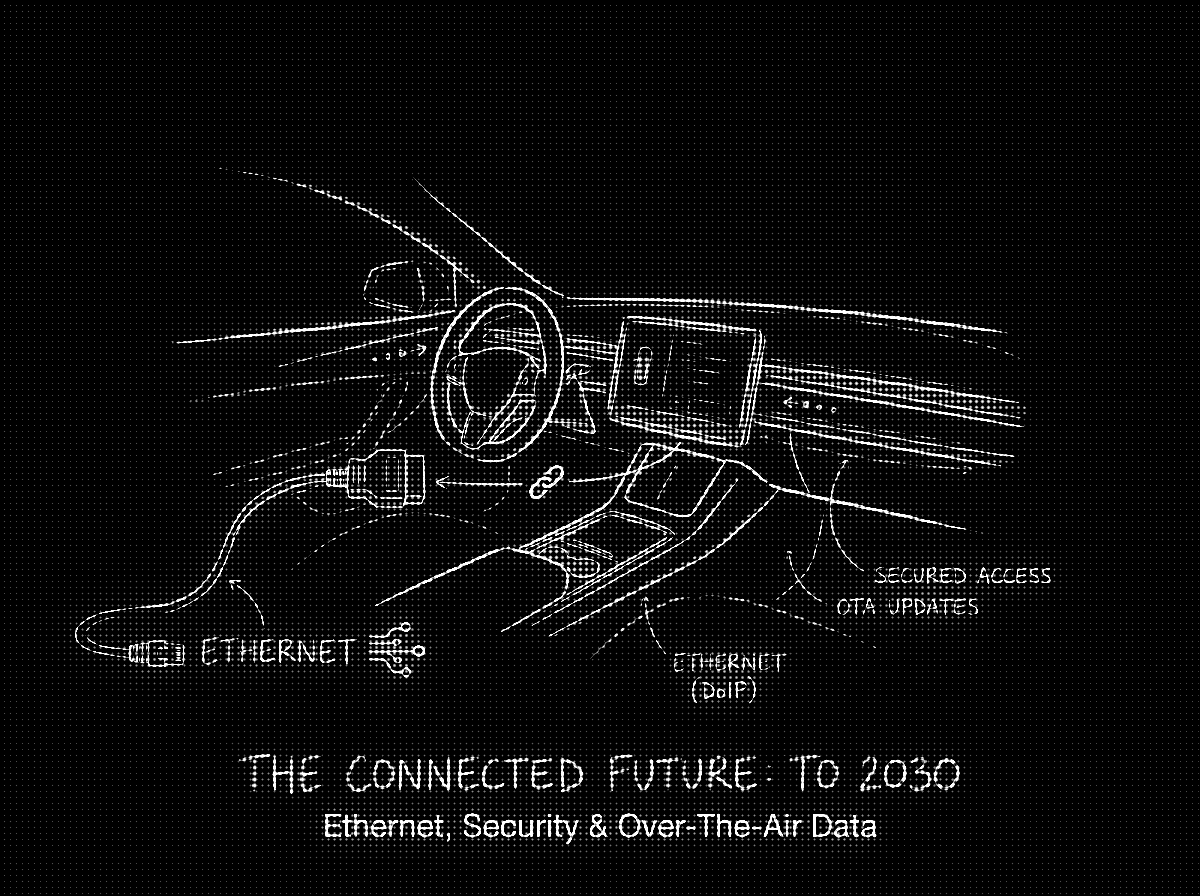
Electric cars have no tailpipe, so the emissions rules never made them fit one, which is why earlier Teslas did their deeper diagnostics through a separate connector. Tesla's own service manual now says Model 3 and Model Y built from April 2024 do diagnostics through the standard port, but over Ethernet, using an OBD-to-RJ45 adapter rather than a normal scanner (Tesla). That one detail sums up where things are going.
THREE CHANGES COMING TO THE PORT
1. A new language
For 30 years generic OBD has spoken SAE J1979, the "modes" and "PIDs" every cheap Bluetooth dongle knows. California is retiring it. Its OBD rules move to a new version built on UDS (the diagnostic protocol manufacturers already use in their own dealer tools), called J1979-2, for 2027 model year cars and later (CARB). Electric cars get their own standard data set, J1979-3, phased in from 40% of 2026 model year EVs to all of them in 2027 (CARB).
Same plug, same wiring, usually the same adapter, but different questions. A scan tool that only knows the old language may see very little from a new car, so every app that reads the port, mine included, has to learn the new one. The EV half is the bit I'm genuinely excited about: for the first time there's a standard battery state of health figure and charge rate that any tool can read, rather than a different formula for every manufacturer (InsideEVs).
One caveat: California's EV rules have been in court since Congress revoked its clean air waiver in 2025 (Jones Day). Manufacturers build one car for all 50 states though, so I'd expect the standard data to show up either way.
2. A firewall behind the port
Every new car sold in the EU now has to meet UN R155, a cybersecurity regulation, and a lot of manufacturers answered it with a secure gateway: a firewall between the port and the rest of the car. Generic emissions data still gets through. On many cars, manufacturer specific data, coding and anything that changes how the car behaves then need a login with the manufacturer. Euro 7 then adds anti-tampering duties on top (NCC Group), so expect more gateways, not fewer.
The EU has at least drawn a line. In 2023 its top court ruled that cybersecurity can't be used as an excuse to lock independent repairers out of the car's data (Osborne Clarke), and since June 2026 a new set of rules spells out which security measures a manufacturer may put on the port and which go too far. Reading fault codes, reading the VIN and universal OBD scanners are exempt from device checks, according to the law firms that have summarised it (Taylor Wessing, Noerr).
3. Ethernet in the same socket
Some new cars carry Ethernet on spare pins of the same 16-pin socket, called DoIP (diagnostics over IP). Tesla is the clearest example, but newer BMW, Jaguar Land Rover and Volvo group cars use it for at least some of their diagnostics too. A normal Bluetooth dongle can't speak it, you need an Ethernet adapter. A few cheap ones already exist for BMWs and work with phone apps over Wi-Fi, so this isn't a dead end for owners, just a different adapter.
US VS EU VS UK, 2026 TO 2030
The three are heading the same way on the technology but very differently on the rules, so here's the short version, then the detail.
| Year | United States | European Union | United Kingdom |
|---|---|---|---|
| 2026 | Standard EV data (J1979-3) starts on 40% of new EVs; REPAIR Act stalls in Congress; EPA "Freedom to Fix" guidance; Polestar refused under the Chinese connected car rule | New OBD security rules (June); owners' data rights built into new connected products (September); Euro 7 for new models (November) | Joins the EU's security access scheme (SERMI); confirms Euro 7; pay-per-mile law drafted |
| 2027 | New UDS-based OBD (J1979-2) on 2027 model year petrol and diesel cars, all new EVs on J1979-3; Chinese and Russian connected car software banned | Battery passport (February); Euro 7 for all new cars (November); Cyber Resilience Act in full (December) | Euro 7 for new cars, with battery health readable by the owner (November) |
| 2028 | Nothing new scheduled federally | Car-sector competition rules (block exemption) expire in May, replacement due | Pay-per-mile for EVs and plug-in hybrids from April |
| 2029 | Connected car hardware ban starts for parts sold without a model year (January) | Nothing fixed yet; the Data Act changes are still being negotiated | UK block exemption expires in May |
| 2030 | Hardware ban applies to 2030 model year cars | 2035 zero emission target stands for now; a softer 90% version is proposed | No more new pure petrol or diesel cars; hybrids until 2035 |
United States: rules on the protocol, fights over everything else
The US is the one market where the standard itself is being rewritten, which is why California matters so much, in practice its OBD rules end up on every car sold in the country. Beyond the protocol though, owner access is a fight. The REPAIR Act, the federal right to repair bill for cars, passed a subcommittee in February 2026 and was then left out of, or heavily cut down in, the full committee's May markup, depending on who you ask (CollisionWeek). In July, after a White House memo, the EPA issued "Freedom to Fix" guidance reminding manufacturers to share emissions repair information, with the memo asking it to go easy on people who repair their own cars back to standard in good faith (EPA).
The other big US change is about where cars come from. A Commerce Department rule bans connected car software with ties to China or Russia from the 2027 model year, and hardware from 2030 (Gibson Dunn). Polestar was refused and will stop selling new cars in the US from 2027, while Volvo, owned by the same Chinese group, was allowed to stay (Top Gear). Chinese brands look set to stay out of the US this decade.
European Union: the strongest data rights, and the most paperwork
The EU is where owners have the most rights on paper. As well as the OBD security rules above, manufacturers have to give independent tool makers software and implementation information from December 2026, with more APIs due in June 2027 (Taylor Wessing, above). The Data Act gives owners a right to their car's data and to pass it to a service they choose, and the Commission's guidance says just telling owners to plug something into the OBD port isn't enough if that data is worse than what the manufacturer's own servers get (Bird & Bird). Brussels is already reopening parts of it in the "Digital Omnibus" (White & Case), so the details will move.
For EV owners the two dates that matter are Euro 7, which brings minimum battery durability rules and battery health monitoring, for new models from November 2026 and every new car from November 2027 (EUR-Lex), and the battery passport from February 2027, which records state of health with tiered access, some of it public, some only for people with a legitimate interest such as repairers (Automotive IQ). Who exactly gets the detailed data still depends on a rule that hasn't been published.
Two more things worth knowing. The competition rules that protect independent garages (the block exemption) run out in May 2028 and the Commission is working on what replaces them (European Commission). And the 2035 end of petrol and diesel isn't as fixed as it was, in December 2025 the Commission proposed a 90% CO2 cut instead of 100%, which would keep some combustion cars and plug-in hybrids on sale (RTÉ). Chinese EVs are still welcome, but with extra duties of up to 35.3% since 2024, or a minimum price agreed with Brussels instead (CMS).
United Kingdom: its own path, and the 2030 deadline
The UK is the one that actually kept a hard date: no new pure petrol or diesel cars from 2030, with hybrids allowed until 2035 (RAC). It is adopting Euro 7 with its own timetable, new cars from November 2027, and battery health readable on the dashboard or through the OBD port (EV Fleet World). On repair data the UK kept the EU rules it had before Brexit but hasn't said whether it will copy the June 2026 changes, though it did join the EU's scheme for security related repair access in April 2026 (SERMI). Its own competition rules for car repair run to May 2029.
The UK change most owners will notice isn't about diagnostics at all. From April 2028 electric cars pay 3p a mile and plug-in hybrids 1.5p, on top of road tax. You give the odometer reading and an estimate when you renew, and MOT mileage records can be used to check it (GOV.UK). So the odometer quietly becomes a tax meter, and the motor industry is already pointing out that MOT garages aren't set up for it (IMI). Meanwhile the MOT still doesn't check battery health at all, even though the industry keeps asking for it (MOT Tester). Unlike the US, there's no ban on Chinese cars, so expect a lot more BYD, MG and friends on UK roads by 2030.
WHAT IT MEANS IF YOU OWN A CAR
- A cheap adapter still works for the basics. Standard data and fault codes stay readable through the port, and in the EU that's now written into law.
- New EVs get a standard battery health number. In the US from the 2026 to 2027 model years, in Europe and the UK with Euro 7. That's huge for used EV buyers, who today mostly have to take the seller's word for it.
- The EVs already on the road don't get it. An I-Pace, an early Leaf or a first generation Kona won't suddenly start reporting a standard figure. For 2015 to 2026 cars battery health still means make-specific reads, and that is a lot of cars.
- Some new cars need a different adapter. If yours uses Ethernet at the port, a Bluetooth ELM327 dongle will only get part of the picture.
- Your mileage starts to matter more. In the UK from 2028 it's a tax figure, so an accurate odometer history is worth keeping.
WHERE EVMETRICSOBD GOES NEXT
These are plans, not promises, and I'd rather under-promise. EvmetricsOBD will learn the new US language, J1979-2 and J1979-3, so new cars read as well as old ones. Where a car reports its own standard battery health figure, I want to show it as the car's own number, next to ours, rather than blending the two. The make-specific work for older EVs stays the core of it, because that's exactly where the standards don't reach.
Long story short: the OBD port isn't dying, it's growing up. By 2030 it speaks a new language, sits behind a firewall, sometimes carries Ethernet, and for the first time tells you how healthy your EV battery is in a standard way. The rules differ a lot between the US, the EU and the UK, but for owners the direction is good, more data, more rights to it, and fewer excuses to keep it from you.