Hybrid GT3RS conversion and track day battery pack
The GT3 RS with the Manthey kit is pretty much the best track car Porsche sells right now, Jörg Bergmeister took one round the Nordschleife in 6:45.389, nearly four seconds quicker than the standard RS (Manthey). It is also one of the last of its kind, a naturally aspirated flat six that revs to 9,000 rpm, so the last thing I would want to do is touch the engine or the gearbox.
So the premise is simple, leave the engine and the PDK alone and put an Elaphe Sonic.1 motor inside each of the four wheels. That makes it a through the road hybrid, there is no mechanical link at all between the engine and the motors, the road does the connecting (the rear motors can even regen against the engine to top the battery up). Then for track days swap the passenger seat for a 50 kWh solid state battery pack. Why? Good question: partly because nobody has done it, partly because I wanted to see what the numbers actually look like, and they are frankly ridiculous.
SONIC.1
Who are Elaphe? A Slovenian company that has been doing in-wheel motors for longer than most EV startups have existed (they did the motors for the Lordstown Endurance pickup, which did not end well for Lordstown). The Sonic.1 was shown at CES in January 2025, it sits inside a 21" rim and still leaves room for a 400mm brake disc, which is the bit that makes it interesting for a car like this. 200 kW continuous and 255 kW peak per wheel, 1,000 Nm continuous and 1,700 Nm peak (electrive, Autoinformed).
The catch is weight, Elaphe quotes over 5 kW/kg continuous so each one is about 40kg, and all of it sits in the wheel as unsprung mass, 160kg across four corners. Italdesign already built a car around four of them, the Quintessenza, a 2,000bhp pickup-ish supercar concept (Autocar), so the idea is not completely mad, just mostly.
SPEC
Now, the numbers. The GT3 RS makes 518hp, four Sonic.1 add 272hp each continuous or up to 347hp each peak, that's about 1,606hp continuous or 1,906hp peak in total, all wheel drive with torque vectoring on every corner. The last column is the same car with the track day pack in, more on that further down.
| Spec | Stock GT3 RS | Converted, continuous | Converted, peak | With track pack, continuous |
|---|---|---|---|---|
| Engine | 518 hp | 518 hp | 518 hp | 518 hp |
| Hub motors (4×) | – | 1,088 hp | 1,388 hp | 1,088 hp |
| Total power | 518 hp | 1,606 hp | 1,906 hp | 1,606 hp |
| Total power (kW) | 386 | 1,186 | 1,406 | 1,186 |
| Motor torque at the wheels | – | 4,000 Nm | 6,800 Nm | 4,000 Nm |
| Drive | RWD | AWD + torque vectoring | AWD + torque vectoring | AWD + torque vectoring |
| Battery | – | 8 kWh | 8 kWh | 8 + 50 kWh |
| Seats | 2 | 2 | 2 | 1 |
| Mass | 1,450 kg | ~1,830 kg | ~1,830 kg | ~2,010 kg |
| hp per tonne | 357 | 878 | 1,042 | 799 |
| 0–62 mph | 3.2 s | ~2.1 s | ~2.0 s | ~2.2 s |
| 0–124 mph | 10.6 s | ~5.0 s | ~4.8 s | ~5.4 s |
| Top speed | 184 mph | ~238 mph | ~259 mph (theoretical) | ~238 mph |
| Downforce at top speed (Manthey aero) | ~1,080 kg | ~1,810 kg | ~2,150 kg | ~1,810 kg |
| Time at full electric power | – | ~36 s | ~28 s | ~4.4 min (in bursts) |
| Electric power once the burst is used up | – | Regen only | Regen only | ~200 kW + regen |
| Electric-only range (gentle driving) | – | ~15–20 miles | – | ~110–140 miles |
| Estimated cost (excluding the car) | – | ~£1M | ~£1M | ~£1.2M |
Not everything scales with power though, here is what actually caps it:
| Limit | What actually caps it |
|---|---|
| 0–62 mph | Tyre grip, not power: more horsepower barely helps |
| Top speed | The engine runs out of revs at 184 mph, so the motors push alone after that. Tyre speed ratings and motor rpm limits would also need checking |
| Peak power | The battery would need to deliver about 1 MW. Peak output only lasts seconds before heat limits kick in |
| Handling | About 160kg of the extra weight sits in the wheels as unsprung mass, which hurts ride and grip on bumpy roads |
| Track pack mounting | The seat rails are rated for a seat and a person, not 200kg in a crash, so the pack needs bolting into the floor and the roll cage |
| Track pack power | Solid state cells are energy cells, about 200 kW (4C) sustained, so the 8 kWh pack still does the bursts and the seat pack refills it |
For context a Rimac Nevera makes 1,914hp at about 2,300kg, so the peak figure puts it in hypercar territory while weighing around 470kg less, and even with the track pack in it's still close to 300kg lighter.
COST
Now the bad part. Estimated total about £0.6M–£1.5M, with roughly £1M most likely. Elaphe sells to carmakers not to private buyers, so this would be a one off engineering programme rather than a parts purchase, and there is no public price for the Sonic.1, so take these as educated guesses. The track day pack is optional and sits at the bottom.
| Item | Qty | Low | High |
|---|---|---|---|
| Sonic.1 motors (low-volume/prototype pricing) | 4 | £60k | £160k |
| Inverters (McLaren IPG5 class) | 4 | £20k | £60k |
| Battery, ~8–10 kWh high-power, with BMS and cooling | 1 | £60k | £150k |
| HV cabling, contactors, DC-DC converter, charger, cooling loops | – | £15k | £40k |
| Bespoke uprights, hubs and suspension rework | 4 | £30k | £80k |
| 21" forged wheels and tyres (RS fronts are 20") | 4 | £10k | £20k |
| Brake integration (400mm discs) | – | £10k | £25k |
| Hardware subtotal | £205k | £535k | |
| Engineering: CAD, FEA, packaging, crash/HV safety | – | £150k | £400k |
| Vehicle controller, torque vectoring and Elaphe traction control integration | – | £100k | £300k |
| Integration with Porsche ECU, PDK and PSM stability control | – | £50k | £150k |
| Track testing and development | – | £50k | £150k |
| UK compliance, HV certification and insurance | – | £10k | £30k |
| Engineering subtotal | £360k | £1.03M | |
| Total (excluding the car) | ~£565k | ~£1.57M | |
| Optional: solid state cells, 50 kWh (sample pricing, £1–3k/kWh) | 1 | £50k | £150k |
| Optional: carbon and aluminium enclosure, seat rail mount, quick release | 1 | £15k | £40k |
| Optional: BMS, cooling fans and window duct, HV connectors | – | £15k | £40k |
| Optional: DC-DC coupling to the 8 kWh pack | 1 | £10k | £25k |
| Optional: engineering, mount crash testing, HV certification | – | £30k | £80k |
| Track pack subtotal | £120k | £335k | |
| Total with track pack (excluding the car) | ~£685k | ~£1.9M |
And the costs that don't show up on the invoice:
| Hidden costs | Impact |
|---|---|
| Porsche warranty | Void |
| Resale value of the car (~£230k) | Likely to fall: buyers prefer originals |
| Porsche ECU access | Locked by Porsche, so integrating the motors with PSM is the hardest part of the job |
| Weight correction | Elaphe quotes over 5 kW/kg continuous for the 21" front motor, which means about 40kg per motor and roughly 380kg added in total, slightly worse than the earlier estimate |
To put it in perspective:
| For comparison | Price |
|---|---|
| Manthey kit | £100k |
| This conversion | ~£1M |
| This conversion + track pack | ~£1.2M |
| Rimac Nevera (1,914hp, ready-made) | ~£2M |
The realistic way to do it would be through Elaphe's partnership with Italdesign, the same people who built the Quintessenza, a commission through them would likely land at the top of that range.
TRACK DAY
Which brings me to the actual problem, the battery. The conversion assumes an 8 kWh high power pack, that's about 36 seconds at full continuous electric power, 28 at peak, a couple of straights and then you're back to a 518hp GT3 RS carrying an extra 380kg around, not exactly the point of a track car.
So the optional bit: on track days the passenger seat comes out and a 50 kWh solid state pack goes in its place, on the same seat rails with a quick release, so it can come out again for the drive home.
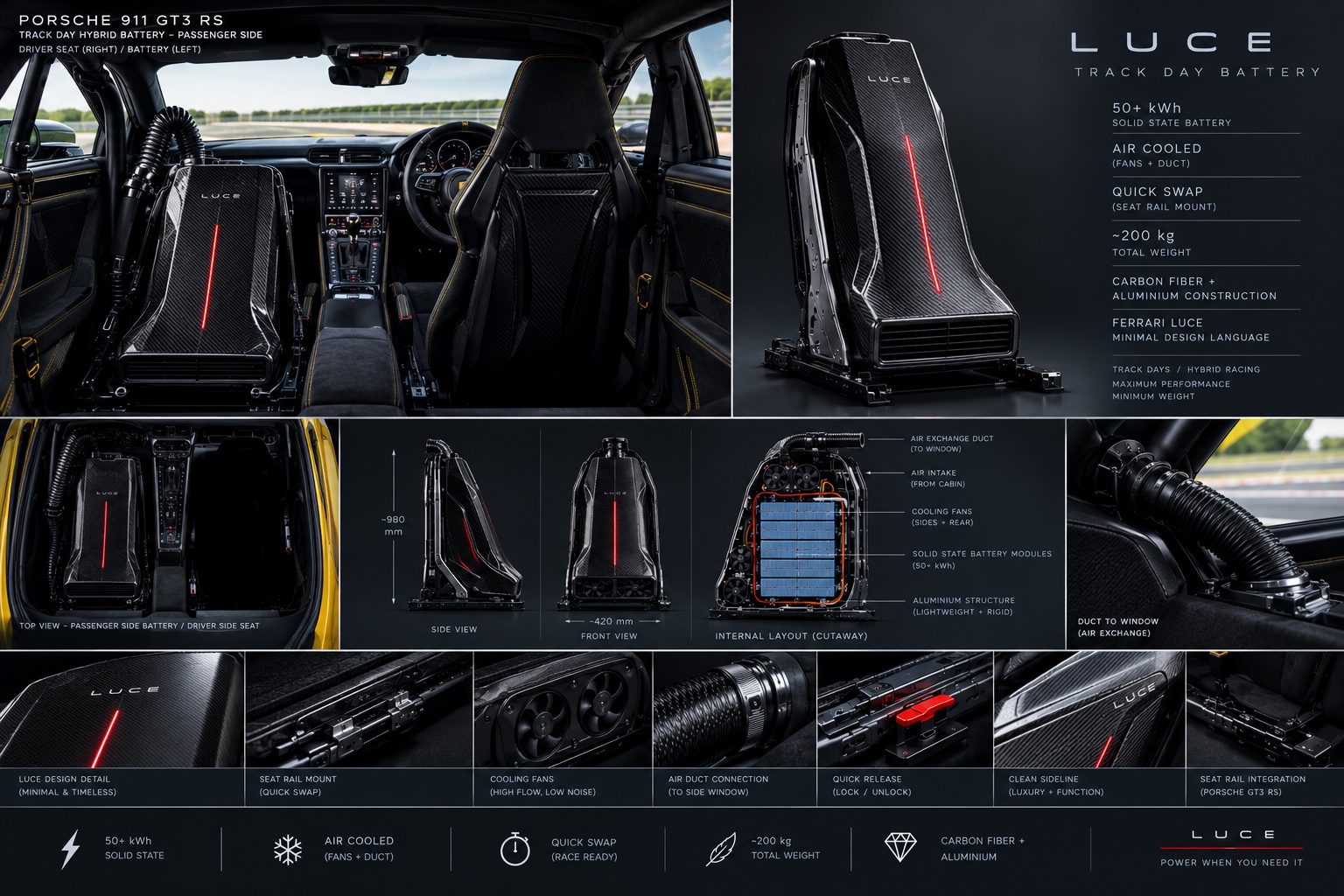
Like the Ferrari Luce, carbon fibre over an aluminium structure, one red light line down the middle and nothing else. It's air cooled, fans pull air from the cabin and push it out through a duct to the side window, solid state cells are more tolerant of heat than the usual liquid electrolyte ones so that's less crazy than it sounds. About 980mm tall, 420mm wide and around 200kg.
Why solid state? Weight. A regular lithium ion pack of 50 kWh would be more like 300kg, and that's a lot to hang off a seat rail. Mercedes already showed what Factorial's cells can do, an EQS that drove 1,205 km from Stuttgart to Malmö on one charge last year (InsideEVs), with the pack co-developed by AMG's F1 powertrain people no less.
That said, solid state cells are energy cells not power cells, they won't dump 800 kW on demand, more like 200 kW sustained (about 4C). So the 8 kWh pack stays, it still does the bursts and soaks up the regen, the seat pack just keeps refilling it, think of the 50 kWh as the fuel tank and the 8 kWh as the turbo. Once a burst is used up you still have about 200 kW (roughly 270hp) of electric on top of the engine, instead of nothing.
How far does 58 kWh go? Back of the envelope, at full continuous electric power it's about 4.4 minutes, and the Manthey RS spends most of its 6:45 Nordschleife lap on the throttle, so that's roughly one lap at full chat. On a 20 minute session you would dial the assist down, more of a boost button than a full time electric car.
Also interesting: when it's not in the car it's still a 50 kWh battery, that's almost four Tesla Powerwalls (13.5 kWh each) and bigger than most home storage setups, so with an inverter it could sit in the garage and run the house between track days.
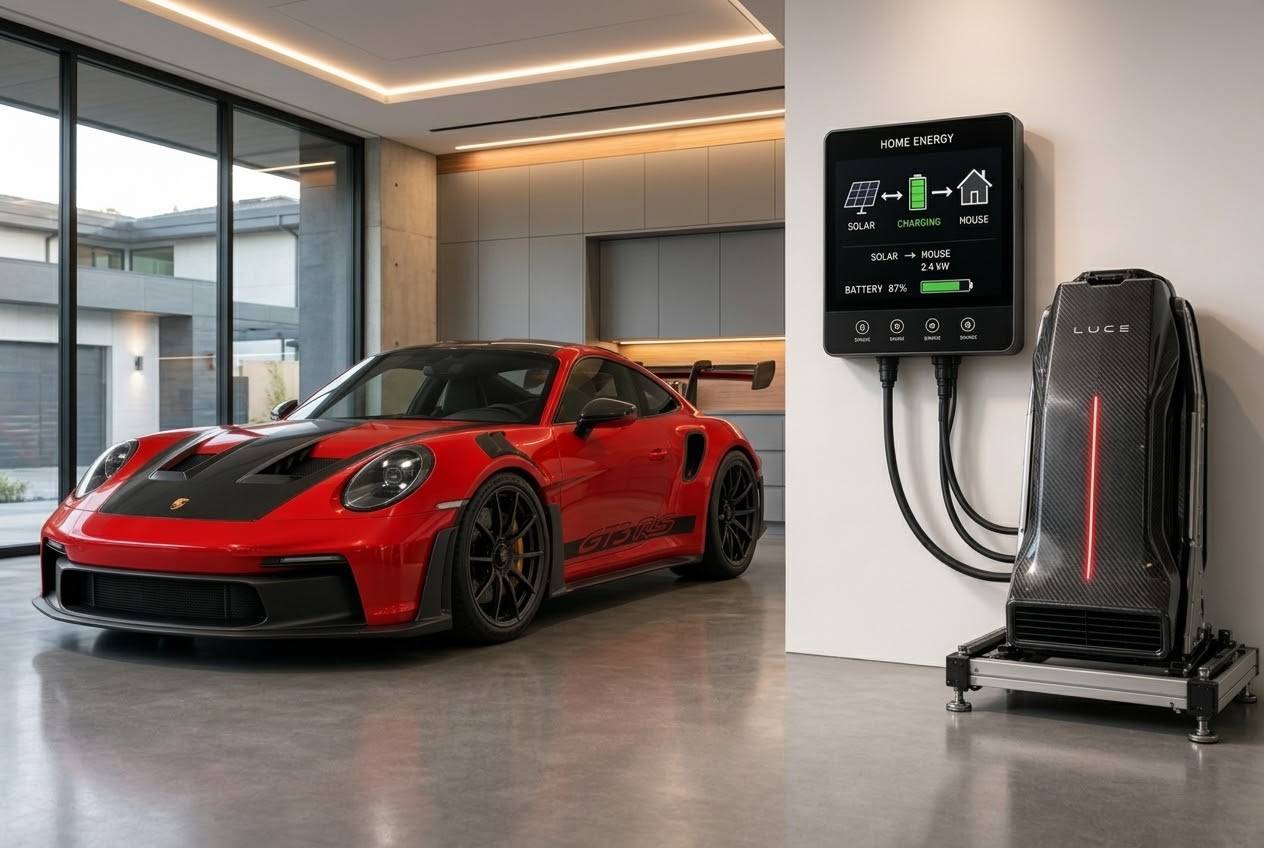
As for backup, that's up to a week for my house if the power goes out. The bigger win is the battery itself, batteries don't like sitting idle for months between track days, running the house keeps it gently cycling between 30 and 80%, which barely dents the cycle count (more in EV charging cycles). Then top it up to 100% the night before a track day.
Back to the track though, the Nürburgring of the future should have a battery swap station. NIO already runs over 4,000 of them in China and swaps a battery in about three minutes (CnEVPost), at a track that could cover full EVs that would otherwise sit on a charger between sessions, and packs like this one, out through the passenger door on its seat rails and a full one back in before the next session.
Long story short: about £1M for the conversion, about £1.2M with the track pack, around 1,900hp peak and four wheel torque vectoring on a car that still revs to 9,000 rpm, a Nevera rival for a bit over half the price with a proper engine still in it. Will anyone build it? Probably not. Should they? Absolutely.